

A screenshot feels like a little slab of reality. It has the right fonts, the familiar bubbles, the tiny timestamp that says, “this happened.” It looks like evidence, not storytelling.
That’s why fake screenshots spread so quickly. They borrow the authority of documentation while keeping the punchiness of a joke. They travel light, too. No context required, no audio to unmute, no long thread to skim. Just a rectangle that seems to prove something, usually something juicy.
The weird part is that many of us know these things can be faked. We know how easy it is. And yet we keep falling for them, or sharing them “just in case,” or forwarding them with a wink because it’s funny even if it’s not true. That tension, between skepticism and impulse, is where the psychology lives.
Screenshots feel like receipts, even when they aren’t
People don’t treat all information the same. A screenshot lands differently than a quote typed into a post, even if the content is identical. The image implies a chain of custody: this was seen, captured, and preserved. It mimics how we collect proof in daily life, like snapping a photo of a parking sign so you can argue later.
This is a cousin of the “seeing is believing” bias. Our brains are built to trust sensory evidence more than abstract description. A screenshot piggybacks on that wiring. It feels like a window rather than a claim.
And because most of us have real screenshots in our own camera rolls, the format triggers familiarity. Familiarity is comforting, and comforting things slip past our mental guardrails.
The new ease of fabrication changed the volume, not the instinct
Ten years ago, faking a convincing chat required design chops or at least patience. Now it’s a couple of clicks and a bit of copywriting. There are generators that let you pick the platform, type the messages, choose the contact name, and export something that looks native. If you’ve ever tried a tool built specifically for a whatsapp chat screenshot, you’ve seen how quickly “evidence” can be manufactured.
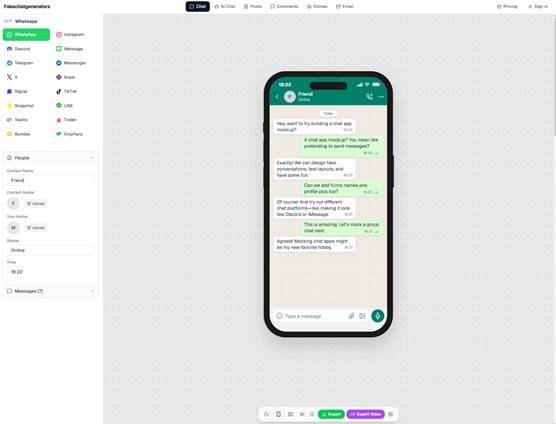
fakechatgenerators.com lets you mock up chat screenshots across 16 platforms
That convenience matters socially. When a medium becomes easy, it becomes casual. Casual things get used for humor, for storytelling, for bullying, for marketing, for drama. The same way photo filters turned everyone into a hobbyist editor, chat generators turn anyone into a micro-forger, sometimes with no malicious intent. The format slides into everyday creativity.
But our instinct to believe “receipts” predates the tools. The tools just flood the zone.
Why we share: the social rewards are immediate
Virality is less about truth than about incentives. On most platforms, you don’t get rewarded for accuracy. You get rewarded for being early, funny, outraged, or “in the know.” A fake screenshot is a shortcut to all four.
A few psychological levers make screenshots especially shareable:
- Low effort, high payoff. One image can deliver setup and punchline without requiring the audience to click anything.
- Compressed narrative. A chat screenshot is already a story in dialogue form. Dialogue is inherently human and easy to process.
- Permission to react. If it looks like a private conversation, it feels like you’re seeing something you shouldn’t. That’s a powerful nudge to comment, judge, and share.
The act of sharing also signals identity. When you pass along a screenshot, you’re not only saying “look at this,” you’re saying “I’m the kind of person who spots this,” whether “this” is a scandal, a hilarious fail, or a perfect clapback.
Gossip is a feature, not a bug
Fake screenshots thrive in the same soil as gossip: social life depends on information about people. Gossip helps groups enforce norms. It tells you who’s trustworthy, who’s dangerous, who’s rising, who’s falling. A chat screenshot, real or fake, arrives prepackaged as social intelligence.
Even when the content is mundane, the format implies intimacy. It’s not a public statement crafted by a PR team. It’s supposedly someone typing with their guard down. That’s the fantasy.
And gossip isn’t only mean. It can be bonding. Friends share a screenshot in a group chat the way they share a look across a table. “Are you seeing this?” becomes a tiny ritual of belonging.
The “private” aesthetic makes it feel more honest
Public posts are performative by default. We assume they’re curated. Private messages, on the other hand, are imagined as unfiltered. That’s why “leaked DMs” have such pull.
Of course, people perform in private messages too, just to a smaller audience. But we don’t feel that when we see a chat interface. The bubbles suggest spontaneity, the typos suggest authenticity, the timestamps suggest sequence. Even the little read receipts, when they’re included, imply the cold reality of being ignored.
This is also why fake screenshots often include small imperfections on purpose. A missing period. A slightly awkward line break. The vibe of real life.
Ambiguity fuels participation
A cleanly debunked claim is boring. A claim that might be true is catnip.
Fake screenshots often sit in the sweet spot of plausible deniability. They don’t need to be airtight. They just need to be possible. That possibility invites people to do what social platforms are built for: speculate.
You can watch the roles appear in the comments like a predictable play:
- The prosecutor: “This confirms what I always knew.”
- The defense attorney: “No way they’d say that.”
- The forensic analyst: “Look at the font kerning.”
- The shrugger: “Even if it’s fake, it’s funny.”
The screenshot becomes a participation prompt. The point isn’t the truth, it’s the performance of deciding.
Outrage and humor both short-circuit careful thinking
Emotion is an accelerator. High-arousal emotions, especially anger and amusement, narrow attention and speed up action. That makes us more likely to share quickly and less likely to verify.
Fake screenshots are tailor-made for this. They often aim for one of two reactions:
- Moral outrage: a villain says the quiet part out loud.
- Social comedy: someone gets roasted, flirts badly, or self-owns.
Both reactions have social value. Outrage signals virtue and group loyalty. Humor signals status and taste. Either way, the screenshot becomes a social token.
And the platforms quietly reward speed. If you pause to verify, you miss the moment. If you share now, you get the dopamine hit of engagement. The result is a culture where “first” often beats “true.”
The credibility of “realism” is easier to fake than people think
Most viewers don’t authenticate images. They do something softer: they judge whether it feels real.
That’s why a fake screenshot doesn’t need to survive forensic inspection. It only needs to survive casual scrolling. On a phone, in motion, between notifications, “good enough” passes as real.
Creators also exploit what psychologists call cognitive ease. If the screenshot matches your expectations, you accept it faster. If it confirms a story you already believe about a person or group, it glides down even faster. This is confirmation bias wearing a new outfit.
It’s not that people are gullible. It’s that the mind is a prediction machine. If a fake screenshot fits the prediction, the brain treats it like a solved puzzle.
Detection tools are rising because trust is now a technical problem
As fabrication gets easier, skepticism becomes exhausting. Individuals can’t realistically verify every image, especially at the speed of social media. That’s why detection is shifting toward tools and systems.
Some platforms and newsrooms use automated screening, including services marketed as an ai image detector that flags AI-generated media, document tampering, and other risk signals. Sightova, for example, claims 98.7% detection accuracy across 50+ generative models, with sub-150ms latency, and it’s pitched to journalists, banks, trust and safety teams, marketplaces, and legal groups. Those numbers matter less as a flex and more as a sign of where we are: trust has become something you measure at scale.
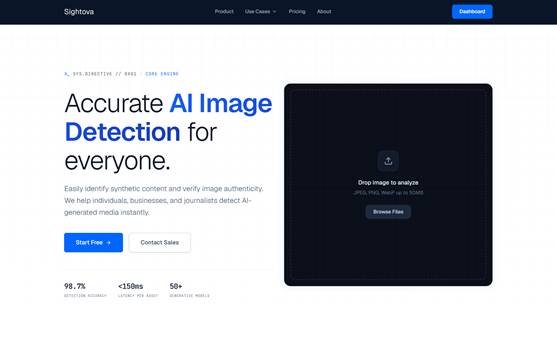
sightova.com flags AI-generated, tampered, NSFW, and violent imagery in milliseconds
Still, detection alone doesn’t solve the social side. People share fake screenshots for identity, humor, outrage, and belonging. A technical label can help, but it doesn’t erase the emotional payoff.
So what actually helps? Friction, context, and a different kind of status
If fake screenshots go viral because they’re easy and rewarding, then the antidotes look a lot like the opposite.
- Add friction. A tiny pause helps. Ask, “What would convince me this is real?” If the answer is “nothing,” you’re not evaluating, you’re auditioning a belief.
- Look for context cues. Screenshots that exclude names, dates, or the surrounding conversation are easier to manipulate. Cropping is not proof of fakery, but it’s often proof of intent.
- Notice your own emotional spike. If it makes you instantly furious or instantly delighted, that’s the moment to slow down.
- Reward the right behavior. In many circles, debunking is treated as killjoy behavior. But accuracy can be its own form of status: being the person who doesn’t get played.
None of this requires becoming paranoid. It’s simply updating our instincts for a world where “receipts” can be generated as quickly as a meme.
Fake screenshots go viral because they sit at a crossroads: our hunger for social information, our trust in visual proof, our need to belong, and our addiction to fast emotions. They’re persuasive not because they’re sophisticated, but because they’re familiar. And familiarity, more than facts, is often what the brain calls truth.